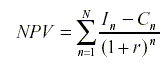
, the rate of returnWhile under way, this type of industrial activity will be faced with issues related to
profitability, technical reliability, socioeconomic side effects and environmental impact problems.
The prior evaluation of the expected return on investment and associated risks
do condition the final decision. The assessment of the degree of risks involved is influenced by the following factors :
- the inaccuracy in the knowledge of the parameters which are used in the estimation of the workable reserves as well as those related to the
predictability of the evolution of the market prices over a long period of time.
- the unpredictable events which may disturb the production and consequently increase its costs : industrial accidents, unwanted catastrophic
effects on the environment, sudden modifications in the sociopolitical context in hosting nations…
- the volatility in the evolution of interests and behaviors of the various initial investment bodies which may result in conflicting situations over time.
The course will demonstrate how it is possible to use Internet in order to gather sufficient information on the basic reserve parameters and adequate reading of the
possible risks which may impinge on the long term profitability of the extraction project. Various models (geographic, environmental, economic, decision-making …)
will be used cooperatively in order to form the best estimation of the proven reserves, evaluate their economic value, estimate the possible risks
and form an opinion on the likely decisions of the various initial investment actors.
In practice, the "geointelligence" approach can be beneficial to the extraction
industry and its shareholders, the investment actors (banks, government bodies, international or regional development aid agencies …) and last but not least, the
numerous partners and contracting companies which are servicing the natural resources industrial projects.
The initial case history used in order to illustrate the course involves the
development of oil fields in Central Africa. But the philosophy of "geointelligence" is much broader and should be applicable to investment decision making situations
related to renewable or non renewable resources at any geographic or economic scales.