1 - Oil resources information 1 - Oil resources information 
2 - Looking for data on the study area
3 - How to assess oil resources
- Assemble data, concepts & ideas – (Petroleum System)
- Evaluate trap volumes – (Probabilistic Framework)
- Secure that appropriate parameters are used – (Reservoir Framework)
- Evaluate dry hole risk – (Success Ratio)
- Inspect accumulation size of known reservoirs – (Log-normal distribution)
- Assess upside potential - (Realistic size ? )
- Secure that the appropriate variability is modelled parameters – (Calibration of uncertainty)
4 - Trap volume parameters
- Closure :
Projected max area enclosing total extent of potential accumulation
- Thickness :
Reservoir thickness
- Volume formation factor :
"in situ" volume compared with surface volume
- Net/gross :
Fraction of reservoir thickness composed of sand
- Porosity :
Fraction of sand pore volume
- Saturation :
Fraction of sand pore volume saturated with oil
- Trap fill :
Fraction of net rock volume saturated with hydrocarbons
- %gas :
Fraction of hydrocarbon volume saturated with gas
- Recovery factor :
Recoverable fraction of "in situ" HC volume
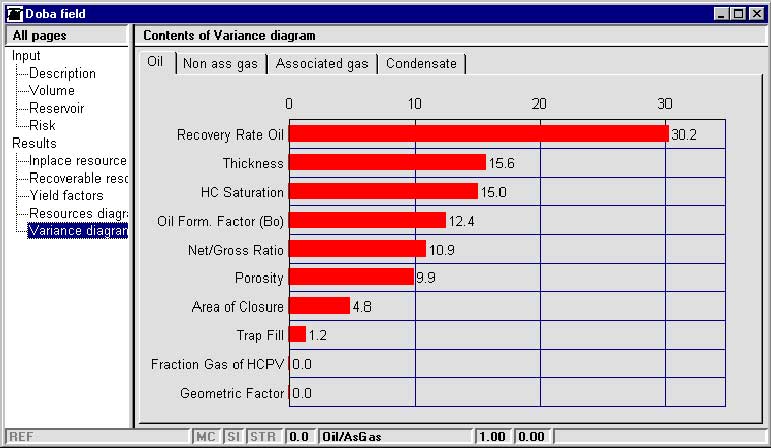
5 - Parameter sensitivity of the resource model
A diagram depicting the sensitivity of the model output to the knowledge uncertainty of each input parameters is an essential tool for
assessing the robustness of the resource evaluation.  
|
[Top of Page] |